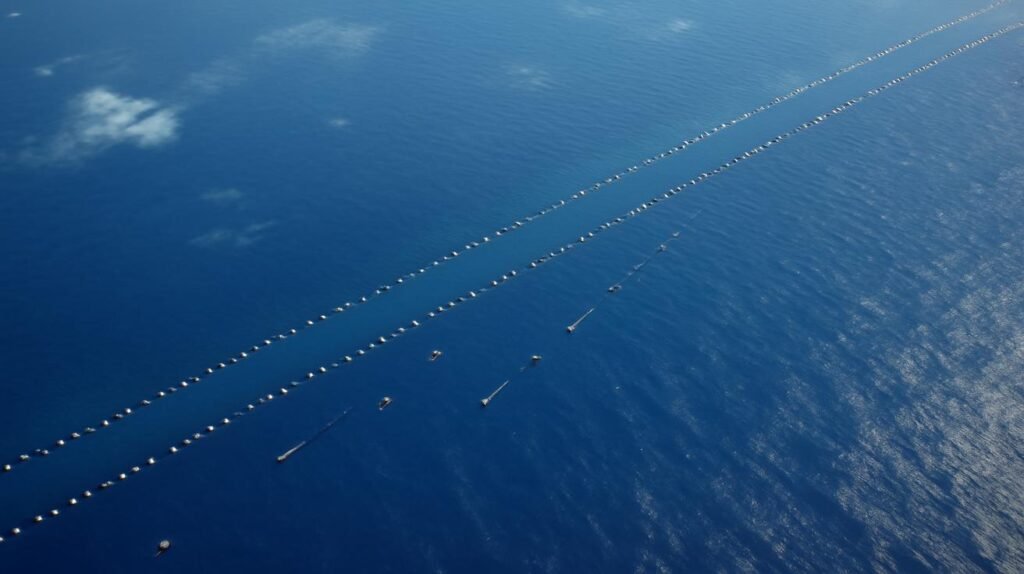
In an unexpected development earlier this year, China reportedly mobilized around 1,400 fishing boats in January to create what observers describe as a 200-mile-long artificial maritime barrier. The unusual movement of vessels quickly drew international attention, raising questions about maritime strategy, regional security, and the growing use of civilian fleets in geopolitical disputes.
Although fishing fleets traditionally operate to harvest seafood, analysts say large coordinated deployments can also serve strategic and territorial purposes, particularly in disputed waters. The event highlights how maritime activities are becoming an increasingly important tool in global politics.
A Massive Fleet Movement That Surprised Observers

The reported mobilization involved hundreds of fishing vessels forming an extended line across a large area of sea, creating what some experts have described as a temporary floating barrier.
Satellite monitoring groups and maritime tracking data suggested that the vessels appeared highly coordinated, maintaining relatively organized spacing across a wide stretch of ocean. Such formations are unusual for normal fishing operations, which typically disperse boats rather than concentrate them in a single line.
Because of this, analysts believe the maneuver may have had strategic signaling or territorial implications rather than purely commercial objectives.
What Is an “Artificial Maritime Barrier”?

An artificial maritime barrier refers to a formation of ships, boats, or floating objects positioned in a way that restricts movement or demonstrates control over a maritime area.
In this case, observers estimated the line of vessels could stretch close to 200 miles (about 320 kilometers). While fishing boats alone cannot permanently block an ocean route, such a large fleet can:
- Demonstrate presence in disputed waters
- Deter other vessels from entering certain areas
- Signal territorial claims or strategic intentions
- Support maritime surveillance activities
The concept is similar to a “maritime wall” made of vessels rather than physical structures.
The Role of Fishing Fleets in Maritime Strategy

China possesses one of the largest fishing fleets in the world, with thousands of vessels operating across regional and international waters.
Experts frequently discuss the idea of a “maritime militia”, a term used to describe fishing boats that may coordinate with government authorities during certain operations. These vessels can play several roles, including:
- Monitoring foreign ships
- Strengthening territorial claims
- Providing logistical support
- Increasing presence in contested regions
Because fishing boats are technically civilian vessels, their deployment can create complex legal and diplomatic situations.
Why the Deployment Raised Global Concerns
The January fleet mobilization attracted international attention because it demonstrated how large numbers of civilian vessels can influence maritime control without direct military involvement.
Security analysts point out several reasons for concern:
- It shows the ability to quickly mobilize a massive fleet.
- It can affect freedom of navigation in sensitive areas.
- It may escalate tensions in regions with existing territorial disputes.
For neighboring countries and global shipping routes, such actions can have significant geopolitical implications.
Strategic Signaling in Modern Maritime Disputes
Modern maritime disputes increasingly involve non-traditional tools, including coast guard ships, research vessels, and fishing fleets.
Instead of direct military confrontation, countries sometimes rely on:
- Civilian maritime presence
- Large-scale fishing operations
- Infrastructure construction at sea
- Surveillance and patrol vessels
These tactics allow governments to assert influence while avoiding direct escalation.
What This Means for the Future of Maritime Security
The January event illustrates how maritime power is evolving in the 21st century. Fishing fleets, once viewed purely as economic actors, are now sometimes part of broader strategic calculations.
As nations compete for resources, shipping routes, and territorial claims, the use of civilian maritime assets could become more common. This development underscores the importance of international maritime law and regional cooperation in maintaining stability at sea.
FAQ
Why did China mobilize 1,400 fishing boats?
Analysts believe the deployment may have been intended to demonstrate maritime presence or strategic positioning in contested waters, though the exact purpose has not been officially confirmed.
What is a maritime barrier made of fishing boats?
It is a formation of vessels positioned across a large area of sea to signal control, deter entry, or monitor activity in the region.
How large was the reported barrier?
Observers estimated the line of vessels could stretch close to 200 miles (about 320 km).
Are fishing boats commonly used in maritime strategy?
In some regions, large fishing fleets are used to increase maritime presence and support territorial claims.
Does this affect international shipping routes?
Large vessel formations in strategic waters can influence navigation patterns and attract attention from maritime authorities and neighboring countries.